Build Fair AI — from strategy to implementation.

The Svrus ecosystem combines the Fairness Implementation Playbook with FairPipe to turn fairness strategy into working ML workflows.
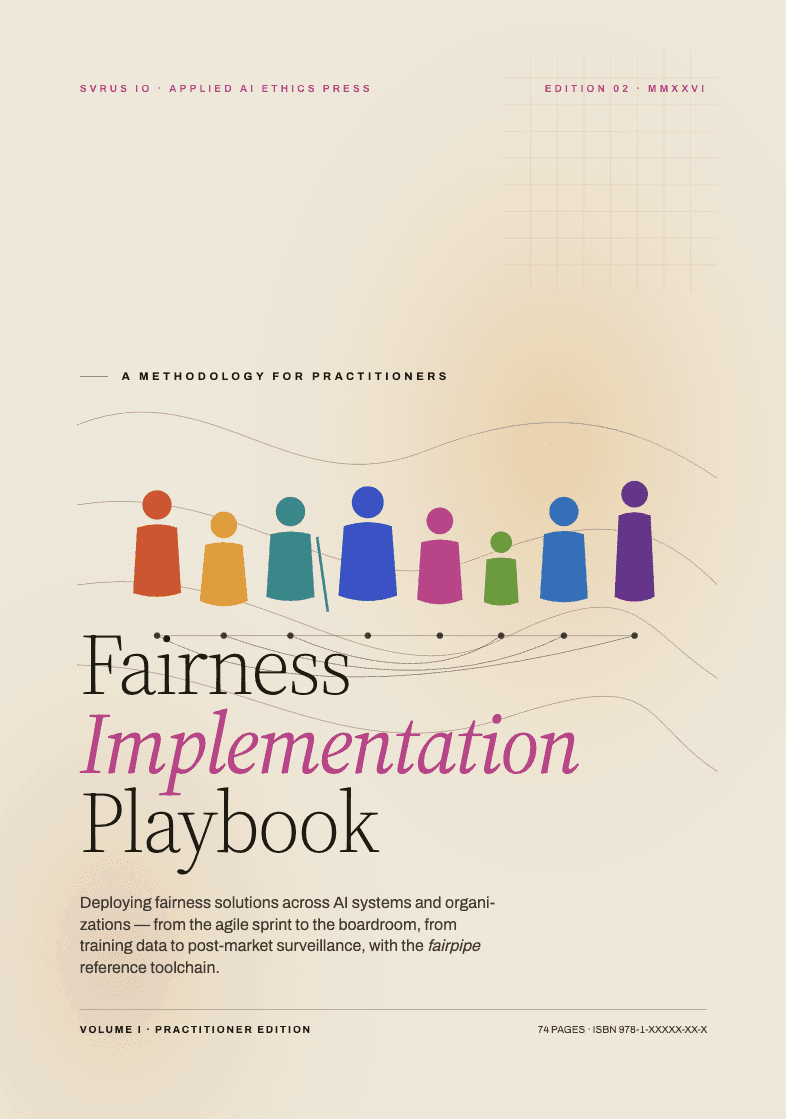
Design fairness and implement it in code with our fairness ecosystem

Design fairness and implement it in code with our fairness ecosystem

Design fairness and implement it in code with our fairness ecosystem

Fairness Implementation Playbook

Fairpipe Python package

A structured implementation methodology for identifying, diagnosing, and addressing bias across the AI lifecycle.

It helps organizations answer the strategic question:

“What fairness intervention should we apply — and why?”

The playbook provides:

AI Scrum Toolkit

Integration & Governance Framework

Regulatory Compliance Guide

Advanced Architecture Cookbook

Fairness Implementation Playbook

Fairpipe Python package

A structured implementation methodology for identifying, diagnosing, and addressing bias across the AI lifecycle.

It helps organizations answer the strategic question:

“What fairness intervention should we apply — and why?”

The playbook provides:

AI Scrum Toolkit

Integration & Governance Framework

Regulatory Compliance Guide

Advanced Architecture Cookbook

Together, the Playbook and FairPipe enable teams to build fairness directly into AI systems rather than auditing it after deployment.

From credit decisions to hiring algorithms, AI increasingly shapes consequential decisions. Yet most fairness efforts break before reaching production.

Common challenges include:

Bias assessed too late in the lifecycle

Ad-hoc interventions instead of systematic workflows

No operational fairness pipelines

Governance and engineering working in silos

The result: fairness initiatives remain diagnostic rather than operational.

Our fairness ecosystem was built to make fairness operational.

Features & Benefits

Features & Benefits

Features & Benefits

01

Fairpipe - the executable fairness toolchain

An installable Python package (PyPI, Apache-2.0) that turns the methodology into running code. One FairnessAnalyzer API for disaggregated and intersectional metrics with bootstrap CIs, YAML-driven bias pipelines with InstanceReweighting and DisparateImpactRemover transformers, optional in-training mitigations (Fairlearn reductions, PyTorch LagrangianFairnessTrainer, GroupFairnessCalibrator), a drift-and-alert engine, MLflow logging and a CI-friendly CLI — so fairness work runs the same in a notebook, a pull request and production.

01

Fairpipe - the executable fairness toolchain

An installable Python package (PyPI, Apache-2.0) that turns the methodology into running code. One FairnessAnalyzer API for disaggregated and intersectional metrics with bootstrap CIs, YAML-driven bias pipelines with InstanceReweighting and DisparateImpactRemover transformers, optional in-training mitigations (Fairlearn reductions, PyTorch LagrangianFairnessTrainer, GroupFairnessCalibrator), a drift-and-alert engine, MLflow logging and a CI-friendly CLI — so fairness work runs the same in a notebook, a pull request and production.

01

Fairpipe - the executable fairness toolchain

An installable Python package (PyPI, Apache-2.0) that turns the methodology into running code. One FairnessAnalyzer API for disaggregated and intersectional metrics with bootstrap CIs, YAML-driven bias pipelines with InstanceReweighting and DisparateImpactRemover transformers, optional in-training mitigations (Fairlearn reductions, PyTorch LagrangianFairnessTrainer, GroupFairnessCalibrator), a drift-and-alert engine, MLflow logging and a CI-friendly CLI — so fairness work runs the same in a notebook, a pull request and production.

02

Fairness embedded in agile, not bolted on

The Fair AI Scrum Toolkit extends every Scrum artefact you already use — the SAFE user-story framework, FAIR acceptance criteria, a fairness Definition of Done, and adapted sprint planning, standups, reviews and retrospectives — so bias detection happens inside the cadence of work rather than as a one-off audit.

02

Fairness embedded in agile, not bolted on

The Fair AI Scrum Toolkit extends every Scrum artefact you already use — the SAFE user-story framework, FAIR acceptance criteria, a fairness Definition of Done, and adapted sprint planning, standups, reviews and retrospectives — so bias detection happens inside the cadence of work rather than as a one-off audit.

02

Fairness embedded in agile, not bolted on

The Fair AI Scrum Toolkit extends every Scrum artefact you already use — the SAFE user-story framework, FAIR acceptance criteria, a fairness Definition of Done, and adapted sprint planning, standups, reviews and retrospectives — so bias detection happens inside the cadence of work rather than as a one-off audit.

03

Organisation-wide governance with clear accountability

A three-tier decision framework, a complete RACI matrix across Product, Engineering, Data Science, UX, Legal and the Executive Sponsor, structured escalation procedures and Fairness Decision Records turn fairness into an owned institutional practice — ending the diffusion of responsibility that lets bias slip through.

03

Organisation-wide governance with clear accountability

A three-tier decision framework, a complete RACI matrix across Product, Engineering, Data Science, UX, Legal and the Executive Sponsor, structured escalation procedures and Fairness Decision Records turn fairness into an owned institutional practice — ending the diffusion of responsibility that lets bias slip through.

03

Organisation-wide governance with clear accountability

A three-tier decision framework, a complete RACI matrix across Product, Engineering, Data Science, UX, Legal and the Executive Sponsor, structured escalation procedures and Fairness Decision Records turn fairness into an owned institutional practice — ending the diffusion of responsibility that lets bias slip through.

04

Architecture-specific recipes for real systems

Dedicated guidance for recommendation systems, large language models, vision models and multi-modal systems — common pitfalls, validation targets and intervention primitives — so teams have a starting point tailored to the kind of model they actually ship, not generic advice.

04

Architecture-specific recipes for real systems

Dedicated guidance for recommendation systems, large language models, vision models and multi-modal systems — common pitfalls, validation targets and intervention primitives — so teams have a starting point tailored to the kind of model they actually ship, not generic advice.

04

Architecture-specific recipes for real systems

Dedicated guidance for recommendation systems, large language models, vision models and multi-modal systems — common pitfalls, validation targets and intervention primitives — so teams have a starting point tailored to the kind of model they actually ship, not generic advice.

05

Regulatory compliance, mapped and evidenced

A five-step compliance guide translates the EU AI Act, GDPR and sectoral regulation into actionable controls, with the Total Risk Score (TRS) formula, tier-based control checklists, evidence-pack templates and continuous monitoring patterns — defensible documentation regulators and auditors can read on day one.pert oversight into every stage of your fairness workflow. From causal assumption reviews to calibration overrides and rejection handling, this protocol ensures critical human judgment complements automation — boosting accountability, transparency, and trust.

05

Regulatory compliance, mapped and evidenced

A five-step compliance guide translates the EU AI Act, GDPR and sectoral regulation into actionable controls, with the Total Risk Score (TRS) formula, tier-based control checklists, evidence-pack templates and continuous monitoring patterns — defensible documentation regulators and auditors can read on day one.pert oversight into every stage of your fairness workflow. From causal assumption reviews to calibration overrides and rejection handling, this protocol ensures critical human judgment complements automation — boosting accountability, transparency, and trust.

05

Regulatory compliance, mapped and evidenced

A five-step compliance guide translates the EU AI Act, GDPR and sectoral regulation into actionable controls, with the Total Risk Score (TRS) formula, tier-based control checklists, evidence-pack templates and continuous monitoring patterns — defensible documentation regulators and auditors can read on day one.pert oversight into every stage of your fairness workflow. From causal assumption reviews to calibration overrides and rejection handling, this protocol ensures critical human judgment complements automation — boosting accountability, transparency, and trust.

Strategic Partnership for Fair AI You Can Trust

Strategic Partnership for Fair AI You Can Trust

Strategic Partnership for Fair AI You Can Trust

We recognize that building fair AI is not just a technical ambition—it’s a structural commitment. One where even the best-intentioned teams struggle to move beyond audits into lasting interventions.

The Fairness Implementation Playbook is more than a framework. It’s a bridge between intention and implementation, designed to equip organizations with the tools, evidence, and human-in-the-loop protocols needed to act decisively.

We believe fairness isn’t an add-on—it’s foundational to resilient, future-ready AI.

We’re committed to walking alongside teams—not ahead of them—with grounded tools and expert support.

Our work is guided by a simple principle: equity that endures must be built into the system, not around it.